

Introduction
Before answering that question, let’s understand the difference between MCBs and MCCBs.
Miniature Circuit Breakers (MCBs) and Molded Case Circuit Breakers (MCCBs) are both types of circuit breakers used for electrical protection. They:
- Are classified as low-voltage breakers (IEC 947)
- Offer overload and short circuit protection
- Provide high durability
- Have almost identical installation and maintenance intervals
But they have distinct characteristics, applications, and capacities. In this short paper we give a comparison between the two.
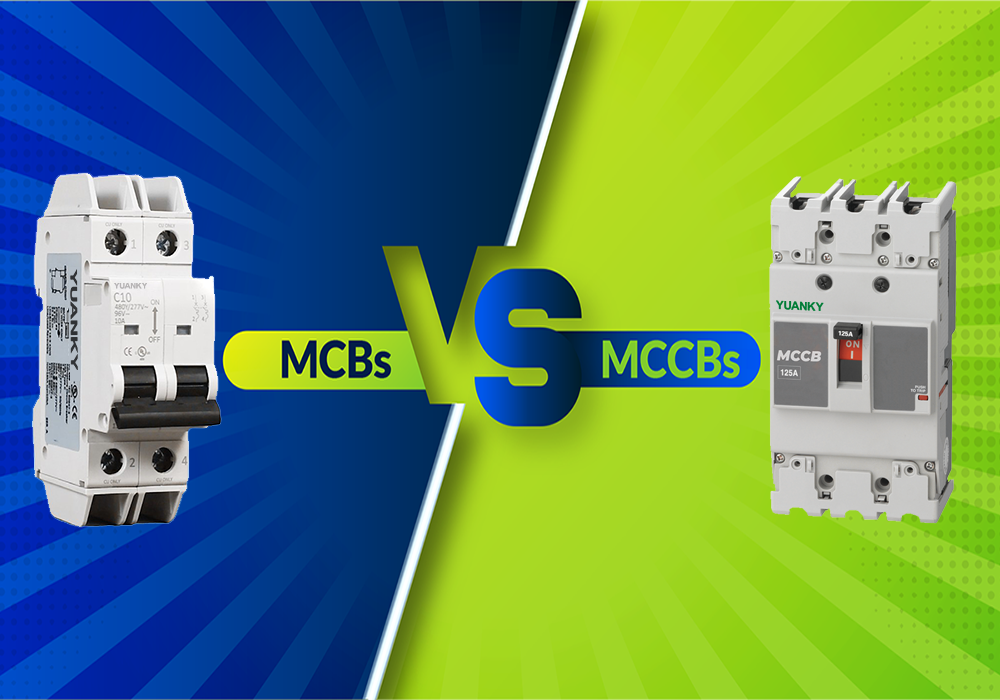
Side by Side Comparison:
Rated Current
- MCBs: Typically rated from 0.5 to 63 Amps.
- MCCBs: Typically rated from 15 Amps to 2500 Amps or more for higher current applications.
Physical Size
- MCBs: Smaller in size, ideal for space-constrained applications. Typically 17.5mm wide per pole, 107.2mm in height. Available in 1, 2, 3 or 4 pole configurations.
- MCCBs: Larger due to their higher current and interrupting capacity. MCCB size varies depending on the current rating, which is known as frame size. MCCBs are typically available in 3 and 4 pole configurations only.
Voltage Rating
- MCBs: Generally used in lower-voltage commercial and industrial applications, typically 120V, 240V or 480Y VAC, and up to 1000 VDC.
- MCCBs: Can be used for both low and high-voltage applications, with ratings typically up to 600V or 690V, and some models rated for higher voltages.
Short Circuit Current Rating (SCCR)
- MCBs: Have an SCCR of up to 10kA.
- MCCBs: Have an SCCR of 10kA to 100kA.
Application
- MCBs: Used in control panels for industrial applications. Typically 1, 2, 3 and 4 pole configurations.
- MCCBs: Used in large commercial and industrial environments where higher currents and fault levels are expected. Typically 3 and 4 pole configurations.
Adjustability
- MCBs: Usually have fixed trip settings and are not adjustable.
- MCCBs: Often have adjustable trip settings for precise control custom to specific applications.
Cost
- MCBs: Low cost due to lower capacity and simpler design.
- MCCBs: More expensive (as much as a couple thousand dollars) reflecting their higher capacity and advanced features.
Usage Flexibility:
- MCBs: Best for low-capacity applications in standard electrical control applications.
- MCCBs: More suitable for main power distribution and high-capacity protections.
Conclusion
In summary, while both MCBs and MCCBs serve the primary function of protecting electrical circuits from overcurrent and short circuits, their specific applications, capacities, and features can differ significantly, catering to different needs in electrical systems. There are applications where MCBs and MCCBs can overlap, making a MCB an alternative choice. The two main drivers are cost and space. MCBs cost considerably less and take up less space in a control panel.
If your application meets the following criteria, MCBs are a great choice to consider.
- Cost and panel space are priorities
- 1, 2, 3 or 4 poles
- Current rating of 63 amperes, or less
- Voltages up to 1000 VDC, or 480Y/277 VAC
- SCCR of 10kA, or less
- Fixed trip curves
Post time: Feb-27-2026