

If you’ve taken a peek into your home’s main electrical panel (or Distribution Board, DB box) in Singapore, you’ll see a row of small switches. These are mostly your Miniature Circuit Breakers (MCBs). But right beside them, or sometimes acting as the main power switch for your entire apartment or house, is often a much larger, more robust breaker. This might be the Moulded Case Circuit Breaker (MCCB).
While both MCB and MCCB are designed to save your property from electrical fires by interrupting excessive current flow, they are engineered for vastly different tasks and scales. For the average Singaporean homeowner, knowing the difference isn’t about choosing one over the other, but understanding why each is placed where it is, and what level of protection it offers.
Let’s break down the core distinctions between the MCB and the MCCB with a focus on home safety.
If you’ve taken a peek into your home’s main electrical panel (or Distribution Board, DB box) in Singapore, you’ll see a row of small switches. These are mostly your Miniature Circuit Breakers (MCBs). But right beside them, or sometimes acting as the main power switch for your entire apartment or house, is often a much larger, more robust breaker. This might be the Moulded Case Circuit Breaker (MCCB).
While both MCB and MCCB are designed to save your property from electrical fires by interrupting excessive current flow, they are engineered for vastly different tasks and scales. For the average Singaporean homeowner, knowing the difference isn’t about choosing one over the other, but understanding why each is placed where it is, and what level of protection it offers.
Let’s break down the core distinctions between the MCB and the MCCB with a focus on home safety.
If you’ve taken a peek into your home’s main electrical panel (or Distribution Board, DB box) in Singapore, you’ll see a row of small switches. These are mostly your Miniature Circuit Breakers (MCBs). But right beside them, or sometimes acting as the main power switch for your entire apartment or house, is often a much larger, more robust breaker. This might be the Moulded Case Circuit Breaker (MCCB).
While both MCB and MCCB are designed to save your property from electrical fires by interrupting excessive current flow, they are engineered for vastly different tasks and scales. For the average Singaporean homeowner, knowing the difference isn’t about choosing one over the other, but understanding why each is placed where it is, and what level of protection it offers.
Let’s break down the core distinctions between the MCB and the MCCB with a focus on home safety.
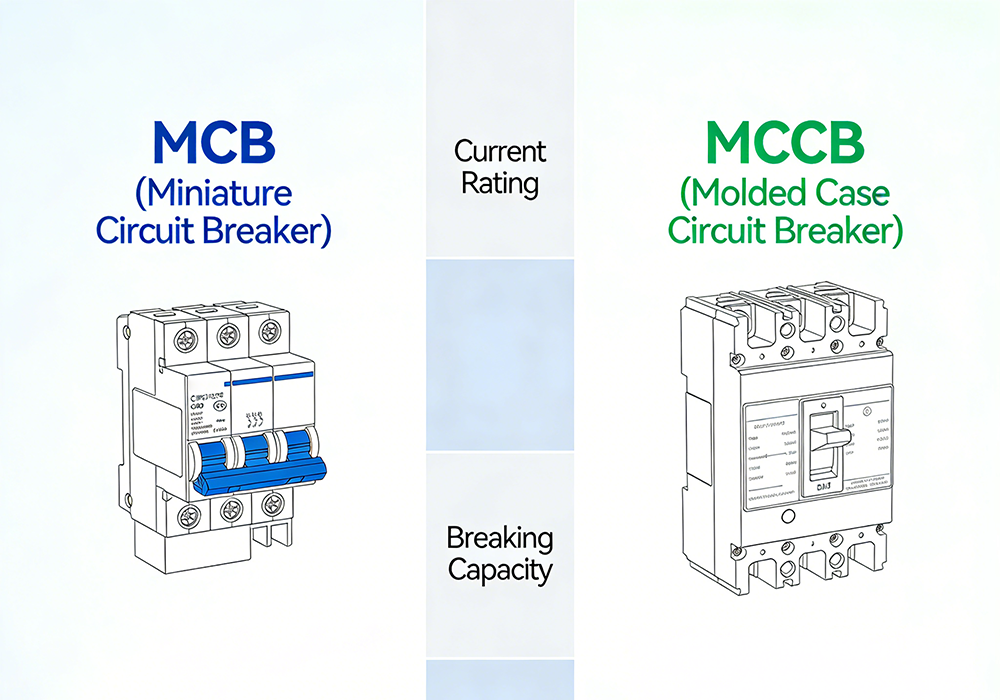
1. What Are MCB and MCCB in Your Electrical Panel?
A. MCB (Miniature Circuit Breaker)
The MCB is the most common type of circuit breaker found in residential and small commercial buildings.
- Role: Protects branch circuits the individual lines feeding your lights, wall sockets, air-conditioners, and water heaters.
- Safety: Protects against low-level overloads and short circuits.
B. MCCB (Moulded Case Circuit Breaker)
The MCCB is a heavy-duty version of the circuit breaker, named for its molded insulated case designed to handle immense heat and current.
- Role: Used for protection in circuits with high current requirements, primarily in industrial and large commercial setups. In residential settings, an MCCB is often used as the main incoming isolation switch, protecting the entire electrical system from the main incoming supply.
- Safety: Designed to withstand and interrupt very high fault currents (high breaking capacity).
2. Difference #1: Current Capacity (The Most Critical Factor)
The most fundamental difference between the two lies in their current handling capacity and interrupting capacity. This dictates where they can be safely used.
| Feature | MCB (Miniature Circuit Breaker) | MCCB (Moulded Case Circuit Breaker) |
| Rated Current Range (What it carries) | Typically 1 Amperes (A) up to 100A (some models up to 125A). | Starts where MCB ends: typically 100A up to 2,500A (or more). |
| Interrupting Capacity (What fault current it can break safely) | Low to medium; typically up to 10 kiloamperes (kA). | High; typically ranging from 10kA up to 200kA. |
The Takeaway for Homeowners: Your general light and socket circuits require low current protection (10A to 32A), making the MCB the perfect, cost-effective choice for all your individual branch circuits. MCCBs are overkill for these small circuits.
3. Difference #2: Adjustability (Fixed vs. Flexible Trip Settings)
This difference is crucial for industrial applications but simplifies the choice for homeowners.
- MCB (Fixed Trip): MCBs come with a fixed, non-adjustable trip setting. For example, a 20A Type C MCB will always trip exactly according to the manufacturer’s specified curve (5 to 10 times the rated current) once the fault criteria are met. This simplicity and consistency are ideal for predictable home circuits.
- MCCB (Adjustable Trip): High-end MCCBs often feature adjustable thermal and magnetic trip settings. This allows electricians or engineers to precisely tune the breaker to suit the exact load profile of high-power machinery or a complex feeder circuit. This flexibility is essential for industrial environments but unnecessary for home use.
4. Difference #3: Physical Size and Construction
Their function determines their form:
- Size: The MCB is small, compact, and designed to clip neatly onto a DIN rail within a residential DB box, maximizing space.
- Size: The MCCB is significantly larger and bulkier. This larger size is necessary to house the stronger arc suppression chambers required to safely extinguish the high-energy arcs generated when interrupting massive fault currents.
- Construction: The MCB is a sealed unit, generally discarded upon failure. The MCCB’s casing is moulded to be incredibly durable, providing superior insulation and protection for its more complex, sometimes modular, internal components.
5. Where Do You Find Them? (Applications & Usage)
| Circuit Breaker | Primary Application | Secondary Application in Singapore |
| MCB | Residential: Branch circuits (lights, power points). | Small retail shops, office lighting circuits. |
| MCCB | Industrial: Protecting heavy machinery, large motors, factory main feeders. | Residential: Often used as the main incoming isolation switch (Main Breaker) in apartment blocks or houses with high power draw (typically > 60A). |
6. Why Does My Home Need Both?
Your home is protected in layers. When your DB box uses an MCCB (or a large-capacity MCB) as the main switch, and MCBs for the rest of the circuits, it provides selective coordination:
- The MCBs (Branch Circuits): These are the first line of defence. If your kitchen socket overloads, only the 20A MCB for the kitchen should trip, leaving the rest of the house lights and aircon running.
- The MCCB/Main Switch (Feeder Circuit): This acts as the final, highest-capacity guard. It only trips if a catastrophic fault occurs that the individual MCBs failed to clear, or if the total power demand exceeds the limit of the entire installation.
This two-tiered system ensures that minor, localized issues don’t shut down the entire home unnecessarily.
7. Is a Higher Capacity MCCB Always Better for Home Use?
No. While the MCCB offers superior technical protection (higher interrupting capacity), installing one on a low-current branch circuit (like your bedroom lights) is both expensive and dangerous.
The purpose of a breaker is to protect the wiring. If you put a massive 100A MCCB on a wire rated for 20A, the wire will burn and potentially cause a fire long before the oversized MCCB detects the fault and trips. Always match the circuit breaker’s current rating to the capacity of the wiring it is protecting.
Frequently Asked Questions (FAQ)
1. Which is better: MCB or MCCB?
Neither is inherently “better.” The choice depends entirely on the application:
- MCB is better for low-current, compact, and cost-sensitive applications (residential branch circuits).
- MCCB is better for high-current, demanding, and adjustable protection applications (industrial mains).
2. What is the main difference in current rating?
MCBs handle currents typically up to 100A. MCCBs handle currents from 100A up to 2,500A (or higher).
3. Can I replace an MCB with an MCCB?
While physically possible in some panels, it is never recommended without professional electrical assessment. Using an MCCB on a low-capacity circuit creates a serious fire hazard by potentially failing to trip before the underlying wiring overheats.
Conclusion
Both the Miniature Circuit Breaker (MCB) and the Moulded Case Circuit Breaker (MCCB) are indispensable safety devices. The MCB handles the daily protection of your individual home appliances, while the MCCB provides the heavy-duty protection needed for the main feeder lines in larger installations.
Ensure your home is safe. If you are uncertain about the type of main switch in your DB box or are considering an electrical upgrade, always consult a Licensed Electrical Worker (LEW) to ensure the correct circuit breaker is installed and complies with Singapore’s electrical safety standards.
1. What Are MCB and MCCB in Your Electrical Panel?
A. MCB (Miniature Circuit Breaker)
The MCB is the most common type of circuit breaker found in residential and small commercial buildings.
- Role: Protects branch circuits the individual lines feeding your lights, wall sockets, air-conditioners, and water heaters.
- Safety: Protects against low-level overloads and short circuits.
B. MCCB (Moulded Case Circuit Breaker)
The MCCB is a heavy-duty version of the circuit breaker, named for its molded insulated case designed to handle immense heat and current.
- Role: Used for protection in circuits with high current requirements, primarily in industrial and large commercial setups. In residential settings, an MCCB is often used as the main incoming isolation switch, protecting the entire electrical system from the main incoming supply.
- Safety: Designed to withstand and interrupt very high fault currents (high breaking capacity).
2. Difference #1: Current Capacity (The Most Critical Factor)
The most fundamental difference between the two lies in their current handling capacity and interrupting capacity. This dictates where they can be safely used.
| Feature | MCB (Miniature Circuit Breaker) | MCCB (Moulded Case Circuit Breaker) |
| Rated Current Range (What it carries) | Typically 1 Amperes (A) up to 100A (some models up to 125A). | Starts where MCB ends: typically 100A up to 2,500A (or more). |
| Interrupting Capacity (What fault current it can break safely) | Low to medium; typically up to 10 kiloamperes (kA). | High; typically ranging from 10kA up to 200kA. |
The Takeaway for Homeowners: Your general light and socket circuits require low current protection (10A to 32A), making the MCB the perfect, cost-effective choice for all your individual branch circuits. MCCBs are overkill for these small circuits.
3. Difference #2: Adjustability (Fixed vs. Flexible Trip Settings)
This difference is crucial for industrial applications but simplifies the choice for homeowners.
- MCB (Fixed Trip): MCBs come with a fixed, non-adjustable trip setting. For example, a 20A Type C MCB will always trip exactly according to the manufacturer’s specified curve (5 to 10 times the rated current) once the fault criteria are met. This simplicity and consistency are ideal for predictable home circuits.
- MCCB (Adjustable Trip): High-end MCCBs often feature adjustable thermal and magnetic trip settings. This allows electricians or engineers to precisely tune the breaker to suit the exact load profile of high-power machinery or a complex feeder circuit. This flexibility is essential for industrial environments but unnecessary for home use.
4. Difference #3: Physical Size and Construction
Their function determines their form:
- Size: The MCB is small, compact, and designed to clip neatly onto a DIN rail within a residential DB box, maximizing space.
- Size: The MCCB is significantly larger and bulkier. This larger size is necessary to house the stronger arc suppression chambers required to safely extinguish the high-energy arcs generated when interrupting massive fault currents.
- Construction: The MCB is a sealed unit, generally discarded upon failure. The MCCB’s casing is moulded to be incredibly durable, providing superior insulation and protection for its more complex, sometimes modular, internal components.
5. Where Do You Find Them? (Applications & Usage)
| Circuit Breaker | Primary Application | Secondary Application in Singapore |
| MCB | Residential: Branch circuits (lights, power points). | Small retail shops, office lighting circuits. |
| MCCB | Industrial: Protecting heavy machinery, large motors, factory main feeders. | Residential: Often used as the main incoming isolation switch (Main Breaker) in apartment blocks or houses with high power draw (typically > 60A). |
6. Why Does My Home Need Both?
Your home is protected in layers. When your DB box uses an MCCB (or a large-capacity MCB) as the main switch, and MCBs for the rest of the circuits, it provides selective coordination:
- The MCBs (Branch Circuits): These are the first line of defence. If your kitchen socket overloads, only the 20A MCB for the kitchen should trip, leaving the rest of the house lights and aircon running.
- The MCCB/Main Switch (Feeder Circuit): This acts as the final, highest-capacity guard. It only trips if a catastrophic fault occurs that the individual MCBs failed to clear, or if the total power demand exceeds the limit of the entire installation.
This two-tiered system ensures that minor, localized issues don’t shut down the entire home unnecessarily.
7. Is a Higher Capacity MCCB Always Better for Home Use?
No. While the MCCB offers superior technical protection (higher interrupting capacity), installing one on a low-current branch circuit (like your bedroom lights) is both expensive and dangerous.
The purpose of a breaker is to protect the wiring. If you put a massive 100A MCCB on a wire rated for 20A, the wire will burn and potentially cause a fire long before the oversized MCCB detects the fault and trips. Always match the circuit breaker’s current rating to the capacity of the wiring it is protecting.
Frequently Asked Questions (FAQ)
1. Which is better: MCB or MCCB?
Neither is inherently “better.” The choice depends entirely on the application:
- MCB is better for low-current, compact, and cost-sensitive applications (residential branch circuits).
- MCCB is better for high-current, demanding, and adjustable protection applications (industrial mains).
2. What is the main difference in current rating?
MCBs handle currents typically up to 100A. MCCBs handle currents from 100A up to 2,500A (or higher).
3. Can I replace an MCB with an MCCB?
While physically possible in some panels, it is never recommended without professional electrical assessment. Using an MCCB on a low-capacity circuit creates a serious fire hazard by potentially failing to trip before the underlying wiring overheats.
Conclusion
Both the Miniature Circuit Breaker (MCB) and the Moulded Case Circuit Breaker (MCCB) are indispensable safety devices. The MCB handles the daily protection of your individual home appliances, while the MCCB provides the heavy-duty protection needed for the main feeder lines in larger installations.
Ensure your home is safe. If you are uncertain about the type of main switch in your DB box or are considering an electrical upgrade, always consult a Licensed Electrical Worker (LEW) to ensure the correct circuit breaker is installed and complies with Singapore’s electrical safety standards.
1. What Are MCB and MCCB in Your Electrical Panel?
A. MCB (Miniature Circuit Breaker)
The MCB is the most common type of circuit breaker found in residential and small commercial buildings.
- Role: Protects branch circuits the individual lines feeding your lights, wall sockets, air-conditioners, and water heaters.
- Safety: Protects against low-level overloads and short circuits.
B. MCCB (Moulded Case Circuit Breaker)
The MCCB is a heavy-duty version of the circuit breaker, named for its molded insulated case designed to handle immense heat and current.
- Role: Used for protection in circuits with high current requirements, primarily in industrial and large commercial setups. In residential settings, an MCCB is often used as the main incoming isolation switch, protecting the entire electrical system from the main incoming supply.
- Safety: Designed to withstand and interrupt very high fault currents (high breaking capacity).
2. Difference #1: Current Capacity (The Most Critical Factor)
The most fundamental difference between the two lies in their current handling capacity and interrupting capacity. This dictates where they can be safely used.
| Feature | MCB (Miniature Circuit Breaker) | MCCB (Moulded Case Circuit Breaker) |
| Rated Current Range (What it carries) | Typically 1 Amperes (A) up to 100A (some models up to 125A). | Starts where MCB ends: typically 100A up to 2,500A (or more). |
| Interrupting Capacity (What fault current it can break safely) | Low to medium; typically up to 10 kiloamperes (kA). | High; typically ranging from 10kA up to 200kA. |
The Takeaway for Homeowners: Your general light and socket circuits require low current protection (10A to 32A), making the MCB the perfect, cost-effective choice for all your individual branch circuits. MCCBs are overkill for these small circuits.
3. Difference #2: Adjustability (Fixed vs. Flexible Trip Settings)
This difference is crucial for industrial applications but simplifies the choice for homeowners.
- MCB (Fixed Trip): MCBs come with a fixed, non-adjustable trip setting. For example, a 20A Type C MCB will always trip exactly according to the manufacturer’s specified curve (5 to 10 times the rated current) once the fault criteria are met. This simplicity and consistency are ideal for predictable home circuits.
- MCCB (Adjustable Trip): High-end MCCBs often feature adjustable thermal and magnetic trip settings. This allows electricians or engineers to precisely tune the breaker to suit the exact load profile of high-power machinery or a complex feeder circuit. This flexibility is essential for industrial environments but unnecessary for home use.
4. Difference #3: Physical Size and Construction
Their function determines their form:
- Size: The MCB is small, compact, and designed to clip neatly onto a DIN rail within a residential DB box, maximizing space.
- Size: The MCCB is significantly larger and bulkier. This larger size is necessary to house the stronger arc suppression chambers required to safely extinguish the high-energy arcs generated when interrupting massive fault currents.
- Construction: The MCB is a sealed unit, generally discarded upon failure. The MCCB’s casing is moulded to be incredibly durable, providing superior insulation and protection for its more complex, sometimes modular, internal components.
5. Where Do You Find Them? (Applications & Usage)
| Circuit Breaker | Primary Application | Secondary Application in Singapore |
| MCB | Residential: Branch circuits (lights, power points). | Small retail shops, office lighting circuits. |
| MCCB | Industrial: Protecting heavy machinery, large motors, factory main feeders. | Residential: Often used as the main incoming isolation switch (Main Breaker) in apartment blocks or houses with high power draw (typically > 60A). |
6. Why Does My Home Need Both?
Your home is protected in layers. When your DB box uses an MCCB (or a large-capacity MCB) as the main switch, and MCBs for the rest of the circuits, it provides selective coordination:
- The MCBs (Branch Circuits): These are the first line of defence. If your kitchen socket overloads, only the 20A MCB for the kitchen should trip, leaving the rest of the house lights and aircon running.
- The MCCB/Main Switch (Feeder Circuit): This acts as the final, highest-capacity guard. It only trips if a catastrophic fault occurs that the individual MCBs failed to clear, or if the total power demand exceeds the limit of the entire installation.
This two-tiered system ensures that minor, localized issues don’t shut down the entire home unnecessarily.
7. Is a Higher Capacity MCCB Always Better for Home Use?
No. While the MCCB offers superior technical protection (higher interrupting capacity), installing one on a low-current branch circuit (like your bedroom lights) is both expensive and dangerous.
The purpose of a breaker is to protect the wiring. If you put a massive 100A MCCB on a wire rated for 20A, the wire will burn and potentially cause a fire long before the oversized MCCB detects the fault and trips. Always match the circuit breaker’s current rating to the capacity of the wiring it is protecting.
Frequently Asked Questions (FAQ)
1. Which is better: MCB or MCCB?
Neither is inherently “better.” The choice depends entirely on the application:
- MCB is better for low-current, compact, and cost-sensitive applications (residential branch circuits).
- MCCB is better for high-current, demanding, and adjustable protection applications (industrial mains).
2. What is the main difference in current rating?
MCBs handle currents typically up to 100A. MCCBs handle currents from 100A up to 2,500A (or higher).
3. Can I replace an MCB with an MCCB?
While physically possible in some panels, it is never recommended without professional electrical assessment. Using an MCCB on a low-capacity circuit creates a serious fire hazard by potentially failing to trip before the underlying wiring overheats.
Conclusion
Both the Miniature Circuit Breaker (MCB) and the Moulded Case Circuit Breaker (MCCB) are indispensable safety devices. The MCB handles the daily protection of your individual home appliances, while the MCCB provides the heavy-duty protection needed for the main feeder lines in larger installations.
Ensure your home is safe. If you are uncertain about the type of main switch in your DB box or are considering an electrical upgrade, always consult a Licensed Electrical Worker (LEW) to ensure the correct circuit breaker is installed and complies with Singapore’s electrical safety standards.
Post time: Mar-12-2026