

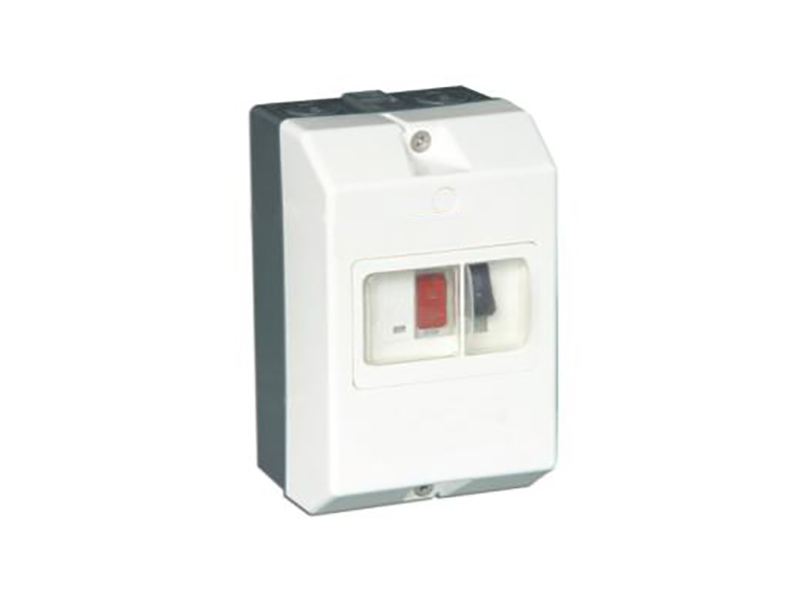
As a core safety protection device for motor equipment in industrial production, the motor protector is a key component for ensuring the stable operation of motors, preventing equipment damage and production safety accidents. Its core function is to monitor the operating status of the motor in real time, promptly identify various abnormal working conditions and trigger protection actions, fundamentally reducing risks such as motor burnout, equipment shutdown, and production interruption, while extending the service life of the motor and reducing operation and maintenance costs. The following is a detailed introduction to the all-round protection system of motor protectors from dimensions such as core functions, extended functions, and application value.
I. Core Protection Function: Building the first line of defense for the safe operation of the motor
(1) Overload protection
Overload is one of the most common fault conditions of motors, often caused by excessive load, mechanical jamming, abnormal power supply, etc., resulting in the motor current exceeding the rated value. The motor protector collects the operating current of the motor in real time and compares it with the preset rated current threshold. When the current continuously exceeds the threshold and reaches the set time limit, the protection mechanism is immediately activated. Its protection logic is designed with inverse-time characteristics – the greater the overload current, the shorter the response time of the protection action. This not only avoids the impact of short-term overload on the motor but also tolerates the instantaneous large current during motor startup, preventing false triggering. For instance, when the load of a 15HP industrial motor abnormally increases, causing the current to rise to 25A (far exceeding the rated value of 18.8A), the protector will cut off the control circuit within seconds to prevent the motor windings from burning out due to long-term overheating and effectively protect the core components of the motor.
(2) Phase loss protection
When a three-phase motor is in operation, if the power supply of one phase breaks (such as poor contact in the line or a blown fuse), it will cause a serious imbalance in the three-phase current of the motor, which in turn leads to problems such as overheating of the windings, reduced torque, and intensified vibration. In severe cases, it may directly burn out the motor. The motor protector monitors the existence and balance state of the three-phase current. When it detects that the current of any one phase is zero or the difference between the three-phase currents exceeds the set threshold (usually 10%-20%), it quickly executes power-off protection. This function is particularly important for industrial motors that rely on three-phase power supply, effectively preventing equipment damage caused by phase loss operation. It is especially suitable for outdoor installation and complex wiring scenarios of motor starters.
(3) Short-circuit protection
Short circuit is the most dangerous fault in motor operation. It is often caused by winding insulation damage, short circuit in the circuit, etc., which leads to a sharp increase in current. The large current generated instantly can cause serious accidents such as motor burnout and fire. The motor protector is equipped with a high-precision current detection module, which can identify abnormal current within milliseconds after a short circuit occurs and quickly cut off the main circuit power supply. Compared with traditional fuses, its short-circuit protection action is more rapid and precise, and it can be reused without frequent replacement of parts. At the same time, it can effectively protect circuit breakers, contactors and other related electrical components from short-circuit impacts.
(4) Overvoltage/undervoltage protection
Abnormal fluctuations in power supply voltage can seriously affect the stability of motor operation: overvoltage can accelerate the aging of motor winding insulation and increase iron loss. Under-voltage will cause the motor torque to decrease and the current to increase, which in turn may lead to overload faults. The motor protector monitors the supply voltage in real time. When the voltage exceeds the preset safety range (such as ±10% of the rated voltage), it immediately issues an alarm signal and cuts off the power supply. For industrial motors with a rated voltage of 460V, the protector can precisely set the protection threshold to prevent voltage abnormalities caused by grid fluctuations, transformer failures, etc. from damaging the motor, ensuring the stable operation of the equipment in complex power supply environments.
Ii. Expanded protection functions: Comprehensive protection adapted to complex industrial scenarios
(1) Three-phase current imbalance protection
When a three-phase motor is in operation, due to factors such as winding impedance differences, wiring errors, and power supply imbalance, three-phase current imbalance may occur. Long-term unbalanced operation can lead to local overheating of the motor, increased vibration, higher energy consumption and shortened service life of the motor. The motor protector calculates the unbalance degree of the three-phase current in real time. When the unbalance degree exceeds the set value, it issues a warning signal. If the condition continues to deteriorate, the power-off protection will be triggered. This function is particularly important for large industrial motors and continuously operating equipment. It can effectively reduce the hidden losses caused by current imbalance and improve the operational efficiency of the motor.
(2) Overheat protection
Overheating of motor windings is one of the core reasons for motor damage. Besides overload and phase loss, excessively high ambient temperature, poor ventilation, and bearing damage can also cause overheating. High-end motor protectors are equipped with temperature detection functions, which can directly monitor the temperature of motor windings or casings through built-in temperature sensors or external sensors such as PT100 and thermocouples. When the temperature reaches the preset alarm threshold, an audible and visual alarm will be triggered. If the temperature continues to rise to the protection threshold, cut off the power supply immediately. This function has been upgraded from “indirect current monitoring” to “direct temperature monitoring”, providing more precise and comprehensive protection. It is suitable for industrial scenarios with high temperatures, high dust levels, and poor ventilation conditions.
(3) Rotor blocking protection
Motor blockage refers to the situation where the rotor cannot rotate due to mechanical jamming, load jamming or other reasons. At this time, the motor current will sharply rise to 5 to 8 times the rated current. If the power supply is not cut off in time, the windings will be burned out in an extremely short period of time. The motor protector monitors the starting current and operating status of the motor. When it detects that the current remains at a high value continuously and the motor speed is zero, it determines a locked rotor fault and promptly executes a protective action. Some high-end products also feature a “locked-rotor pre-alarm” function, which issues a warning when the current abnormally rises but does not reach the locked-rotor threshold, facilitating operators to promptly identify faults and prevent equipment damage.
(4) Under-load protection
In addition to overload, under-load operation of the motor (with too low a load) may also cause malfunctions. For instance, when pumps and fan equipment are idling, insufficient flow may lead to equipment damage. The motor protector can set a minimum load threshold. When the motor current remains persistently below the threshold, it is determined as an under-load fault, and an alarm is issued or the power supply is cut off to prevent ineffective energy consumption and component wear caused by long-term idled operation of the equipment. It is especially suitable for equipment such as pumps, fans, and compressors that have specific load requirements.
Iii. Auxiliary Functions: Enhance operation and maintenance efficiency and system compatibility
(1) Status monitoring and display function
Modern motor protectors are equipped with clear LCD or LED display interfaces, which can show motor operation parameters in real time, such as three-phase current, voltage, power, temperature, operation time, etc., and present the equipment operation status (normal, alarm, fault) intuitively at the same time. Operators can quickly grasp the motor operation status through the display interface without the need for additional detection instruments, which greatly enhances the convenience of operation and maintenance. Some products also support parameter query functions, which can record historical fault data (such as fault type, occurrence time, and current/voltage values at the time of fault), providing an important basis for fault detection.
(2) Alarm and communication functions
The motor protector is equipped with multiple alarm methods, including sound and light alarm, relay output alarm, etc., which can promptly remind the operator to pay attention to equipment abnormalities. Meanwhile, high-end products support industrial communication protocols such as Modbus, Profibus, and CAN, enabling data interaction with control systems like PLC and DCS, and uploading the motor’s operating status and fault information to the central monitoring platform. Managers can remotely and in real time monitor the operation of multiple motors from the monitoring center, achieving centralized management and remote diagnosis. This significantly enhances the automation and intelligence levels of industrial production, and is particularly suitable for large-scale factories, production lines and other scenarios where multiple motors are centrally controlled.
(3) Adjustable parameters and adaptive functions
Motors of different models and specifications have different requirements for protection parameters. The motor protector supports flexible Settings of parameters such as protection threshold and action time limit, and can be adapted to motors of different powers and types (such as asynchronous motors, synchronous motors, variable frequency motors, etc.). Some products also feature adaptive functions, which can automatically identify parameters such as the rated current and power of the motor, simplifying the debugging process, reducing operational difficulty, and enhancing the efficiency of equipment installation and maintenance.
(4) Interlocking control function
The motor protector can be interlocked with electrical components such as contactors, circuit breakers, and frequency converters for control. When a fault is detected, in addition to cutting off its own control circuit, it can also send control signals to related equipment, achieving system-level safety protection. For instance, when a short-circuit fault occurs in the motor, the protector can simultaneously cut off the power supply of the frequency converter and trigger an emergency shutdown of the production line to prevent the fault from expanding and ensure the safety of the entire production system.
Iv. Application Value: Comprehensive Empowerment from security Protection to cost reduction and efficiency improvement
The core value of motor protectors lies not only in preventing motor damage, but also in creating multiple values for industrial production through all-round protection and intelligent operation and maintenance support. From a safety perspective, it can effectively prevent safety accidents such as fires and equipment damage caused by motor failures, ensuring the personal safety of operators and the stability of the production environment. From an economic perspective, it can extend the service life of motors, reduce the cost of spare parts replacement, and at the same time lower the production interruption losses caused by equipment downtime. From the perspective of efficiency, it reduces the workload of manual inspection, enhances operation and maintenance efficiency, and helps enterprises achieve lean production through real-time monitoring and remote diagnosis functions.
In equipment such as 15HP industrial combined motor starters, motor protectors (such as electronic overload relays) serve as core components and are used in conjunction with circuit breakers, contactors, etc., to form a complete protection system of “detection – alarm – protection – linkage”. Ensure the stable operation of the motor in an industrial environment of 460V, 3-phase, and 60Hz, providing reliable safety guarantees for various industrial production scenarios. With the improvement of industrial automation levels, motor protectors are developing in the direction of intelligence, networking and integration. They are not only “safety guardians”, but also have become important data nodes in the industrial Internet of Things system, providing strong support for enterprises to achieve digital transformation.
Post time: Jan-20-2026