

Are your expensive electronics safe? A Whole-House Surge Protection Device (SPD) is the silent guardian that watches the electricity entering your home. It acts as a gatekeeper, instantly redirecting dangerous voltage spikes into the ground before they can fry your circuit boards.
In this comprehensive guide, we will explore the internal mechanism of a whole-house surge protector, explain exactly how it diverts excess voltage to keep your appliances safe, and why—in the age of the IoT (Internet of Things)—it is no longer optional but essential.
The Physics of a Power Surge: The Invisible Threat
To understand the solution, we must first understand the problem. A power surge, or transient overvoltage, is a temporary spike in voltage that lasts for mere microseconds but can reach thousands of volts.
In a standard US electrical system, your voltage should oscillate around 120V/240V at 60Hz. A surge disrupts this wave. According to the National Fire Protection Association (NFPA), electrical failures or malfunctions are a leading cause of home fires, and surges often play a triggering role by degrading insulation over time.
Where Do Surges Come From?
While dramatic lightning strikes get all the attention, they only account for about 20% of surges. The other 80% are far more insidious.
- Internal Switching (The 80%): Every time your refrigerator compressor kicks on, or your A/C unit starts up, it creates a small inductive load spike. These “mini-surges” happen dozens of times a day. They may not blow a fuse instantly, but they cause “electronic rust,” slowly degrading the sensitive microchips in your smart devices.
- Grid Switching: Utility companies constantly switch grids to manage load. This can send ripples of inconsistent voltage into your home.
- Lightning: Rare but catastrophic. A direct or nearby strike can send hundreds of thousands of volts through power lines, cable lines, or even plumbing.
Deep Dive: How a Whole-House SPD Mechanism Works
A whole-house SPD is wired into your main electrical panel. Think of it as a pressure relief valve for electricity. Its job is to detect excess voltage and divert it to the grounding wire.
The Core Component: Metal Oxide Varistor (MOV)
The heart of most modern SPDs is the Metal Oxide Varistor (MOV). This component is a variable resistor.
- Under Normal Conditions: The MOV has extremely high resistance. It acts like an open door, allowing electricity to flow normally to your lights and appliances.
- During a Surge: When voltage exceeds a specific limit (the clamping voltage), the MOV’s resistance drops to near zero in nanoseconds.
- The Diversion: It becomes a “short circuit” for the excess energy, shunting the current safely into the grounding wire and away from your home’s wiring.
For more critical applications, some SPDs combine MOVs with Gas Discharge Tubes (GDT) or Silicon Avalanche Diodes (SAD) for faster response times or higher current handling capabilities.
The Importance of Response Time
Speed is everything. A surge moves at the speed of light. If your SPD is too slow, the damage is done before the device activates. High-quality SPDs, like those offered by YUANKY, react in less than one nanosecond.
Types of Surge Protection Devices: 1, 2, and 3
Not all surge protectors are created equal. The National Electrical Manufacturers Association (NEMA) and UL standards categorize them into three types. For complete protection, you need a “Tiered Approach.”
| Type | Location | Primary Function | Ideal For |
|---|---|---|---|
| Type 1 | Meter Side (Outside) | Stops high-energy external surges (lightning) before they enter the building. | Industrial buildings or homes in high-lightning areas. |
| Type 2 | Panel Side (Inside) | The standard for residential homes. Mounted on the load side of the main breaker. | Protecting the entire branch circuit system and hardwired appliances. |
| Type 3 | Point-of-Use | Plug-in power strips. The last line of defense. | Sensitive electronics like TVs, PCs, and Gaming Consoles. |
Expert Recommendation: A robust protection strategy involves installing a Type 2 SPD at your main panel to handle the heavy lifting, supplemented by Type 3 strips for your most sensitive gear.
NEC 2020/2023 Code: Why It’s Mandatory Now
If you are building a new home or upgrading your service panel in 2026, you likely don’t have a choice—you must install surge protection. The National Electrical Code (NEC) updated its requirements in Article 230.67.
This code mandates that all new and replaced services supplying dwelling units must be provided with a Type 1 or Type 2 Surge Protective Device. This change reflects the reality that modern homes are filled with sensitive electronics (LED lighting, smart washers, GFCI breakers) that are highly vulnerable to power quality issues.
Installation and Maintenance: What You Need to Know
Professional installation ensures the grounding path is effective.
Installation Best Practices
While you can buy an SPD online, installation is not a DIY project for amateurs. It involves working inside a live electrical panel.
- Lead Length Matters: The wires connecting the SPD to the breaker should be as short and straight as possible. Bends and long wires increase impedance, which reduces the SPD’s ability to divert fast-moving surges.
- Breaker Compatibility: The SPD typically connects to a dedicated double-pole circuit breaker (e.g., 20A or 30A) inside your panel. Ensure you have compatible Circuit Breakers for your specific panel brand.
Maintenance: The “Sacrificial” Nature of MOVs
It is crucial to understand that SPDs are sacrificial devices. Every time they absorb a surge, the MOVs degrade slightly. A massive lightning strike might destroy the SPD instantly—but in doing so, it saves your $3,000 smart fridge and $5,000 HVAC system.
How to check if it works: Most units come with LED indicators.
- Green Light: Protected.
- Red Light / No Light: The MOVs have sacrificed themselves, and the unit needs replacement immediately.
Related Safety Technologies: SPD vs. RCD vs. MCB
Homeowners often confuse these three critical safety devices. Let’s clarify:
- MCB (Miniature Circuit Breaker): Protects wires from overheating due to overload (too many appliances) or short circuits.
- RCD (Residual Current Device): Protects people from electric shock. It detects current leakage. Learn more about our YUANKY RCD Protectors.
- SPD (Surge Protection Device): Protects equipment from voltage spikes.
For a truly safe home, you need all three working in harmony.
The Smart Investment: Why YUANKY?
When it comes to electrical safety, quality cannot be compromised. At YUANKY, we have spent decades refining circuit protection technology.
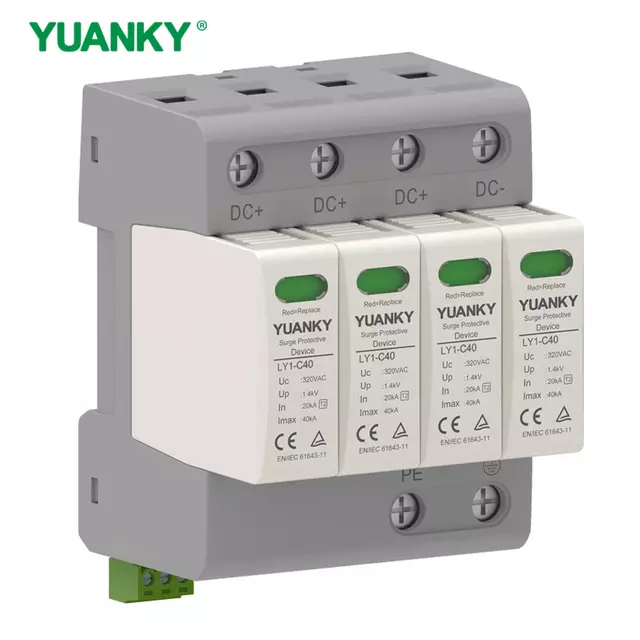
Featured Product: YUANKY Whole-Home SPD Series
Our latest generation of Surge Protection Devices is designed for the modern 2026 smart home.
- High Surge Capacity: Capable of handling up to 100kA surges, ensuring robust protection against external spikes.
- Thermal Disconnect Technology: Prevents fire hazards if the MOV reaches end-of-life.
- Visual Status Indicators: Clear LED displays so you always know you are protected.
- Universal Compatibility: Designed to fit seamlessly alongside standard din-rail circuit breakers.
Don’t leave your expensive appliances vulnerable to the grid’s unpredictability.
Conclusion
A whole-house surge protector is an essential component of modern home maintenance. By diverting excess voltage to the ground within nanoseconds, it protects your investment in appliances, entertainment systems, and smart home technology.
Remember, surges happen every day, mostly silently. Don’t wait for a catastrophic storm to realize the value of protection. Whether you need a Type 2 SPD for your panel or a comprehensive RCD solution, ensuring your electrical system is up to code is the best insurance policy you can buy.
Frequently Asked Questions (FAQ)
Post time: Mar-05-2026