

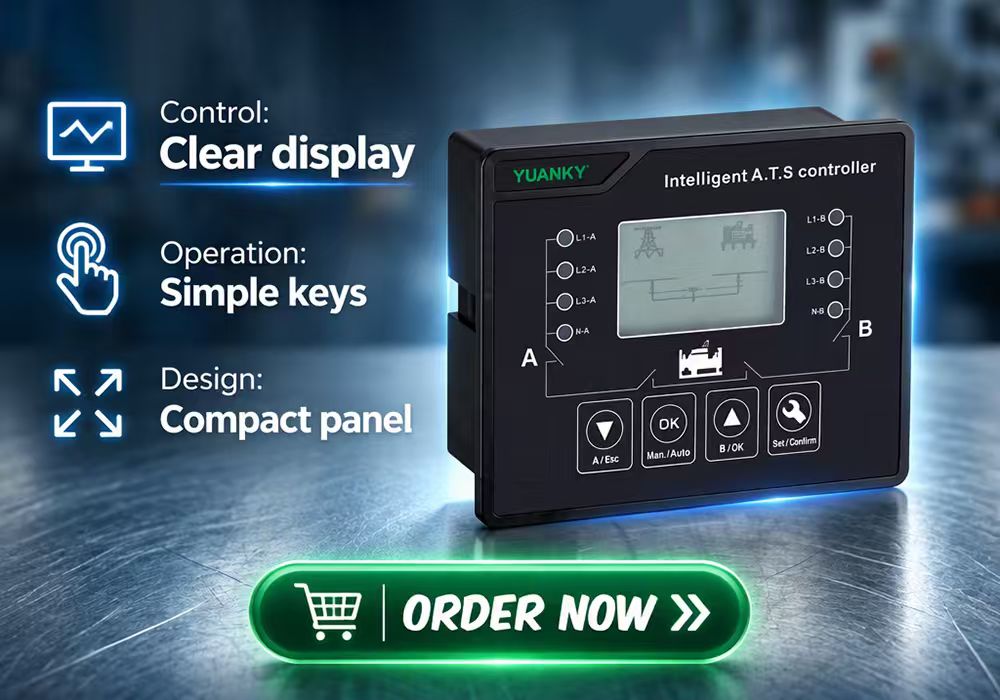
The internal structure of ATS (Automatic Transfer Switch) mainly consists of the operating mechanism, main contact system, controller, drive device, arc extinguishing device and terminal blocks, etc. The operating mechanism is responsible for driving the contacts to switch, achieving the conversion between the common power supply and the backup power supply. The main contact system typically consists of two sets of power contacts for connecting or disconnecting different power circuits. The controller is responsible for monitoring the voltage, frequency and phase loss status of the two power supplies. When the common power supply fails, the controller issues a switching command, and the power conversion is completed by the motor or electromagnetic drive mechanism. Arc extinguishing devices are used to reduce the arc generated when contacts break, enhancing the safety of equipment operation. Terminal blocks are used to connect common power supplies, backup power supplies and load lines. Some ATS systems are also equipped with mechanical interlocks and electrical interlocks to prevent two power sources from being connected simultaneously and to avoid safety risks caused by parallel power supply connections. ATS is widely used in factories, commercial buildings, data centers and emergency power supply systems, which can enhance the continuity and reliability of power supply. Different models of ATS vary in contact structure, conversion speed, control mode and rated current. When selecting a model, the actual load and power supply requirements should be taken into consideration.
Post time: Oct-27-2026